In the observation car, ringed by picture windows, an Indian couple sits leaning forward like they're ready devour the mountainsides. The woman, in an orange sari that brings a bit of color to the train's blue and white retro aesthetic, holds a video camera at chest level. Every now and again they look down to make sure the camera is pointed in generally the right direction, and then they stare forward again, back out of the windows, camera rolling and entirely disregarded.
I think about the sunset I saw while heading west on the Empire Builder. Swirling clouds, the roiling pinks and yellows, the reflection in a perfectly smooth pool - you know the type. I whipped out a camera and snapped one shot, two, three, messing with the settings to try to get one striking one - and then I turned the camera off and set my forehead against the window. The photos never turn out well with the glass in the way.
Who knows why we take these pictures? To prove we were here, to make our friends and family jealous, to remind ourselves later? We record these visions like its an obligation, something to get out of the way before we get back to the real work of staring. And staring. And staring.
We won't print these pictures out and put them on our wall. We won't turn to them in times of trouble or nostalgia. We'll pack them away, and barely ever look at them again. The photos are like stones we drop to mark our way - someday in the future, if we need to retrace our steps, these small and otherwise worthless artifacts will be there to show the path we followed. For now we take snapshots, Hansel with a digital camera - snap, snap, snap, here's where we went - but keep our eyes, restless, on the tracks before us.
Showing posts with label photos. Show all posts
Showing posts with label photos. Show all posts
Monday, July 4, 2011

Wednesday, June 22, 2011
New York, New York
In New York City by myself with lots of free time, no map or guideback, and very little cash. What to do? What to do?

Get myself to Central Park, of course! and I only got a LITTLE lost on the subway...
Dear Diary, Today I learned the difference between "Express" and "Local"...

Get myself to Central Park, of course! and I only got a LITTLE lost on the subway...
Dear Diary, Today I learned the difference between "Express" and "Local"...


When Natasha collected my poor bewildered soul, the REAL tour of Manhattan started. Here's Park Ave!

The next day, I checked out the Highline, like Tasha said I should. IT WAS SO COOL.


Then I went to the meatpacking district. I bet these two businesses are great neighbors!

Did I go to Chelsea Market? Why yes I did.
Did I wander around Greenwich Village? Yup! Did I take any pictures? Nope!

Did I go back to the highline to play in Rainbow City? Yes I did!

And then did I watch the sun set behind the highline? well, not quite, but almost! It was a pretty good two days in New York... except for the many, many hours I spent talking to Amtrak reps.
But let's focus on the positive!

Sunday, June 13, 2010
Street Portraits
I've mentioned everybody's enthusiasm for being photographed - here's a sampling of the portraits I've taken (most at the subject's demand) during my trip so far.
Keep an eye out for spiderman and the kids playing pokemon.
Keep an eye out for spiderman and the kids playing pokemon.


photos from letre
okay, so I know my blog is way less entertaining than Emily's, 'cuz I'm just not that funny. and it features way fewer baby dolphins than Jenny's, 'cuz some of us just aren't lucky enough to be working with baby dolphins. And I'm super wordy and kind of boring a lot of the time. So I was thinking, what could I blog about that would bring a smile to people's face? what would be a nice, happy post?
and sorry, folks. I got nothing to bring you joy. Instead, I have pictures of children playing on dump sites and swimming in polluted waters. get excited for a trip to Letre, Malabon, population: 55,000, poverty: overwhelming.

You might recall that I mentioned Malabon before - it's a town built on a dump site, where a former fishpond was filled with trash until it became somewhat like a solid surface. The settlers then built their houses on top of the trash. The windows in the community are weirdly low, and the ceilings of many of the houses awkwardly close to the ground, because every year the occupants have to pile up more trash and concrete on the ground in order to stave off the rising waters. There are regular floods and fires, and if the owner of the land ever decides to use it for something, the squatters - informal settlers - will be relocated to whereever the city or landowner can find to put them. Sometimes Malabon makes it into the news because settlers forcibly resist relocation, with violent results.

As you would expect in a community built on a trash heap, hygiene and health are huge, huge issues. Common diseases include childhood diarrhea, dengue, and leptospirosis. Leptospirosis is also known as "the one spread through rat piss," in case you were wondering.


That's what the young women I interviewed, who were showing us through the community, called it. "Ate Camila, we're going to the mountain of trash now!"
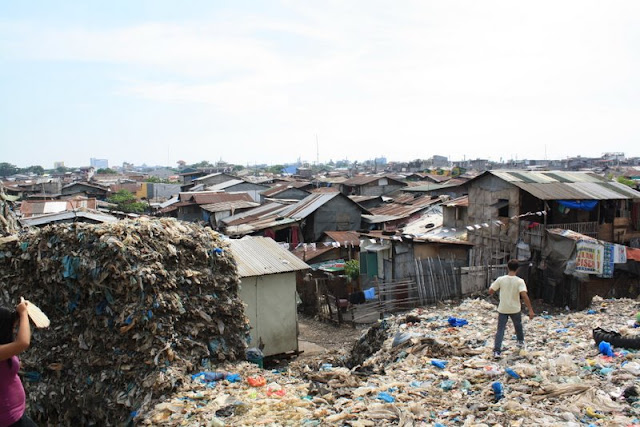


and sorry, folks. I got nothing to bring you joy. Instead, I have pictures of children playing on dump sites and swimming in polluted waters. get excited for a trip to Letre, Malabon, population: 55,000, poverty: overwhelming.

You might recall that I mentioned Malabon before - it's a town built on a dump site, where a former fishpond was filled with trash until it became somewhat like a solid surface. The settlers then built their houses on top of the trash. The windows in the community are weirdly low, and the ceilings of many of the houses awkwardly close to the ground, because every year the occupants have to pile up more trash and concrete on the ground in order to stave off the rising waters. There are regular floods and fires, and if the owner of the land ever decides to use it for something, the squatters - informal settlers - will be relocated to whereever the city or landowner can find to put them. Sometimes Malabon makes it into the news because settlers forcibly resist relocation, with violent results.

As you would expect in a community built on a trash heap, hygiene and health are huge, huge issues. Common diseases include childhood diarrhea, dengue, and leptospirosis. Leptospirosis is also known as "the one spread through rat piss," in case you were wondering.

"Stepping stones" across the trash-filled waters.
Electricity is also a big issue - many informal settlements will illegally tap electricity, which is dangerous and can help cause fires. Speaking of fires, one of the most amazing things to me when traveling through these communities is that anybody manages to survive the fires that occur. The streets are so very narrow.

Water delivery is also a big issue. It can be carried in by hand, like this man is doing, or delivered by portable hose, or there can be an installed hose. But any of those methods can deliver contaminated water.

See the blue line in the lower right-hand corner? That's a water pipe, running right through the waters of Malabon, filled with trash and human waste. A tiny crack anywhere in that hose will cause serious health problems. Note also the skinny cat, the neatly mended old shirt, the woman doing laundry in front of her home - other characteristics of life in an informal settlement.
Speaking of the trash, it's everywhere. and it smells terrible. but it's not actually overpowering until you reach the mountain.

That's what the young women I interviewed, who were showing us through the community, called it. "Ate Camila, we're going to the mountain of trash now!"

And as we gingerly picked our way across the top - a very squishy experience - they asked, "Ate Camila, you aren't scared?" And well, yes, I was scared - scared I was going to step in something I'd never forget, that I was going to slip and fall, that my injured ankle would give out. but I wasn't too scared to keep going, so we climbed up to the top for a panoramic view of Malabon.

Old men, beneath the shade of a tarp, were picking through trash, while small children climbed across the top, sorting through looking for valuables, or maybe just playing - or both. It involved a lot of running and laughing, while I was hyperventilating at the sight of tiny feet in flimsy flipflops on top of that poisonous filth. but man, were those kids adorable.

A river runs through the middle of Letre, crossed by these flimsy bridges.

The water is also full of garbage and naked children swimming - with a great deal of enthusiasm and some rather skillful dives. However, I think posting those pictures might earn me a child-pornography arrest, so you'll have to take my word for it. Diving from the shores into the water not a foot away from a floating island of trash.

Some parts of Letre are rather more developed - you can see much more concrete in this section, for instance. But they face the same flooding problems.

Are they carrying rocks in, to build up the ground and fight the flooding? or carrying them out? I didn't think to ask.
And throughout it all, poverty, and ramshackle houses, and unattended children, and hard, hard work, and of course, the trash. But as I said in my last post on Malabon, the experience was surprising. The young women I spoke to about their volunteer work passing out condoms and providing sex education, the mothers in the maternal hospital, the kids shouting and following us, begging for me to take pictures of them and asking for my name, all the patient adults who smiled and moved aside to let us through the streets - I remember the people, not the trash.

Oh, and the sense of guilt. I remember that, too.
banaue, batad, baguio. B is for Beautiful.

The view out the window while we ate breakfast in Banaue. "We" was me, a german dude, and a dutch chick. Lotsa western backpackers in Banaue.

Rice terraces of Banaue. They're throughout the whole city, next to houses, restaurants, shops, the road - the agricultural woven into the urban, farming amongst the buildings.


City center - it was market day, so lots of tricycle traffic.

Unfortunately, I completely failed to get a good picture of one of the overloaded jeepneys, with passengers crowded on top. This was actually the best I got. Sorry.

The road to Batad.

This was the toilet - or "comfort room" - at the saddle, the start point of the hike down to Batad. It is a terrifying experience to step on that rickety wooden platform.


And this, friends, is why Batad is only accessible by foot.

The amphitheater at Batad - world heritage rice terraces.

Me being a dweeb.

It is actually overwhelming when you turn around the corner of the trail and see the amphitheater spread out before you. I'm not sure the photos convey how HUGE this is.

The town itself

My guide, Margie, as we get ready to enter the terraces themselves.

85 years old. Poses in traditional Ifugao clothing in a nipa hut so that tourists like me can take pictures of him, and asks for donations in return. Nice guy. He liked my camera - said it would take very clear photos of him.

Scarecrows to keep the birds from eating all the rice.

Up close and personal with a rice plant.

Hike a little farther - but it feels a lot farther in the midday heat - and you'll reach this waterfall.

Some people swam, but I didn't - stuck in a toe and dang, that water was cold.

My ride down the mountain. More on that later.

And finally, I reached Baguio - that's the city blurrily behind me. No rice terraces there, but lovely pine trees and a very nice central park and downtown area.
Sunday, June 6, 2010
Quiapo Market
I have loads of photos to share - let's start with Quiapo Market!
It was my first real adventure here. I rode a jeepney and the public train and wandered around a crowded market all byyy myyyyself... and was thrilled to discover that i was not raped, killed, tortured, robbed or even glared at, hence easing many of my big-city fears. I did, it is true, almost melt from the heat, but that was the worst of it!
Quiapo Market is noted in my guidebook as a great place to visit, but no other tourists seemed to be heeding the call. It was me and approximately five gazillion locals, who were selling their wares or doing their shopping in a massive, labyrinthine open-air market.

Now, when I think of an open-air market, I think of fruits...

and vegetables...


and other tasty foodstuffs.

(these pretty eggs are labeled "maalat," which means salty, so i'm pretty sure they're salted eggs. I haven't eaten any purple salted eggs yet, though. Salted eggs are - well - they're kind of strange and gray-ish on the inside, but mostly seem to taste like... eggs. Not so sure what's special about them)
But at Quiapo Market, they don't just sell these items, they sell everything. EVERYTHING. In the same kind of stalls, lining both sides of the narrow streets, with colorful umbrellas and items displayed on little tables with hand-written signs... EVERYTHING.

I didn't believe it myself until I had wandered past the clothes section into electronics (the stalls are roughly arranged by category, but not precisely). And then after passing several stalls that only sold videoke equipment, I passed one selling cleaning products, another selling hardware and tools, and then - after getting lost and winding up on a footbridge - a row of stalls selling dildos.
And that's when I knew. Yup. Everything.
(And no, I was far too embarrassed to take pictures!)
At the heart of Quiapo Market, there's Quiapo Church.

It's rather lovely. Stalls closest to the church sell lots of religious icons and statues.


Also, abortifacents.

Needless to say, the law doesn't much dissuade these vendors. They sell their wares as medicines to treat "menstrual problems" (which is one way to put it), The abortifacent industry at Quiapo is part of the very serious topic of reproductive health in the Philippines, and the consequences of abortion being banned and discussion and distribution of contraceptives being limited. If you'd like to read more on the subject, check out this NYT article. Note, however, a lie the reporter includes at the end of the article - a pro-life activist blames sex education for the high rate of abortions. There is no sex education in Filipino schools. Hence...
I'm still learning about all of these issues, and the reproductive health bill that's been debated for years is looking to be a major focus of my project. But right now all I'll say is that half of all pregnancies in the Philippines are unintended, and at least a third of those unintended pregnancies are terminated through illegal abortions. Wealthy women have access to safe abortions, but poor women use the the unregulated drugs and herbs at Quiapo or a variety of very, very dangerous brute-force methods. Some hospitals refuse to treat post-abortion complications, or brutally mistreat and abuse women who come for help after a botched abortion, causing the over a thousand of women per year. Thousands more die of complications of pregnancy or during childbirth (understandable when you consider both the poor state of health care and that it may be their sixth pregnancy... or seventh. or eighth. or ninth. or...) And meanwhile the Catholic Church continues to block efforts to teach sex education in the schools or make contraception readily available in poor communities.
I'm not exactly neutral on the subject, to say the least. As I see it, the bishops and the politicians they control have the blood of desperate poor women on their hands, and it is downright criminal to ban the distribution of condoms (yes, the mayor of Manila actually banned them for a while) when unintended pregnancies are not only perpetuating the cycle of poverty but actually leading to the deaths of thousands.
Anyway. Back to Quiapo.
I was pretty nervous about pulling out my camera in the market. I already looked like a total outsider, and didn't really want to label myself even more thoroughly as a foreigner. Worse, I would be taking pictures of people's everyday activities - it felt intrusive and annoying, and I fully expected to be met with irritation when I asked if i could take a photo.
Boy, was I wrong.

The vast majority of the people I've photographed actually asked to have their pictures taken. They would shout, upon seeing my camera, "One shot! One shot!" and strike a pose - silly, serious or smiling, depending, but always a pose. And sometimes, after happily obliging with a photo, they'd grab some friends and pull them in and shout, 'One more! One more!" I've learned a new tagalog word, "kodakan," roughly meaning "Take a picture of me!"

At any rate, I had no trouble finding smiling faces to photograph. I did, however, have difficulty taking any photos of people that weren't staged - if I tried to take a picture of a vendor who was busy with his wares, his neighbor would tap him on the shoulder and point at me, and the vendor would turn around, give a little shout, and... you guessed it... strike a pose! Other times I would ask permission to take a picture of somebody who would laugh, nod, and ignore me - so I have a few candid shots.


other photos... PEDICABS!


It was my first real adventure here. I rode a jeepney and the public train and wandered around a crowded market all byyy myyyyself... and was thrilled to discover that i was not raped, killed, tortured, robbed or even glared at, hence easing many of my big-city fears. I did, it is true, almost melt from the heat, but that was the worst of it!
Quiapo Market is noted in my guidebook as a great place to visit, but no other tourists seemed to be heeding the call. It was me and approximately five gazillion locals, who were selling their wares or doing their shopping in a massive, labyrinthine open-air market.
okay, you can't see the five gazillion people in this photo, but I promise they were there
Now, when I think of an open-air market, I think of fruits...
and vegetables...
and other tasty foodstuffs.
(these pretty eggs are labeled "maalat," which means salty, so i'm pretty sure they're salted eggs. I haven't eaten any purple salted eggs yet, though. Salted eggs are - well - they're kind of strange and gray-ish on the inside, but mostly seem to taste like... eggs. Not so sure what's special about them)
But at Quiapo Market, they don't just sell these items, they sell everything. EVERYTHING. In the same kind of stalls, lining both sides of the narrow streets, with colorful umbrellas and items displayed on little tables with hand-written signs... EVERYTHING.
I didn't believe it myself until I had wandered past the clothes section into electronics (the stalls are roughly arranged by category, but not precisely). And then after passing several stalls that only sold videoke equipment, I passed one selling cleaning products, another selling hardware and tools, and then - after getting lost and winding up on a footbridge - a row of stalls selling dildos.
And that's when I knew. Yup. Everything.
(And no, I was far too embarrassed to take pictures!)
At the heart of Quiapo Market, there's Quiapo Church.

It's rather lovely. Stalls closest to the church sell lots of religious icons and statues.

Also, abortifacents.

Needless to say, the law doesn't much dissuade these vendors. They sell their wares as medicines to treat "menstrual problems" (which is one way to put it), The abortifacent industry at Quiapo is part of the very serious topic of reproductive health in the Philippines, and the consequences of abortion being banned and discussion and distribution of contraceptives being limited. If you'd like to read more on the subject, check out this NYT article. Note, however, a lie the reporter includes at the end of the article - a pro-life activist blames sex education for the high rate of abortions. There is no sex education in Filipino schools. Hence...
I'm still learning about all of these issues, and the reproductive health bill that's been debated for years is looking to be a major focus of my project. But right now all I'll say is that half of all pregnancies in the Philippines are unintended, and at least a third of those unintended pregnancies are terminated through illegal abortions. Wealthy women have access to safe abortions, but poor women use the the unregulated drugs and herbs at Quiapo or a variety of very, very dangerous brute-force methods. Some hospitals refuse to treat post-abortion complications, or brutally mistreat and abuse women who come for help after a botched abortion, causing the over a thousand of women per year. Thousands more die of complications of pregnancy or during childbirth (understandable when you consider both the poor state of health care and that it may be their sixth pregnancy... or seventh. or eighth. or ninth. or...) And meanwhile the Catholic Church continues to block efforts to teach sex education in the schools or make contraception readily available in poor communities.
I'm not exactly neutral on the subject, to say the least. As I see it, the bishops and the politicians they control have the blood of desperate poor women on their hands, and it is downright criminal to ban the distribution of condoms (yes, the mayor of Manila actually banned them for a while) when unintended pregnancies are not only perpetuating the cycle of poverty but actually leading to the deaths of thousands.
Anyway. Back to Quiapo.
I was pretty nervous about pulling out my camera in the market. I already looked like a total outsider, and didn't really want to label myself even more thoroughly as a foreigner. Worse, I would be taking pictures of people's everyday activities - it felt intrusive and annoying, and I fully expected to be met with irritation when I asked if i could take a photo.
Boy, was I wrong.
The vast majority of the people I've photographed actually asked to have their pictures taken. They would shout, upon seeing my camera, "One shot! One shot!" and strike a pose - silly, serious or smiling, depending, but always a pose. And sometimes, after happily obliging with a photo, they'd grab some friends and pull them in and shout, 'One more! One more!" I've learned a new tagalog word, "kodakan," roughly meaning "Take a picture of me!"
At any rate, I had no trouble finding smiling faces to photograph. I did, however, have difficulty taking any photos of people that weren't staged - if I tried to take a picture of a vendor who was busy with his wares, his neighbor would tap him on the shoulder and point at me, and the vendor would turn around, give a little shout, and... you guessed it... strike a pose! Other times I would ask permission to take a picture of somebody who would laugh, nod, and ignore me - so I have a few candid shots.
Cutting manggang hilaw - unripe mango. really tasty with salt. i haven't been brave enough to try it with shrimp paste...
That stuff she's making was de-freaking-licious. I didn't notice her shirt until just now...
Glutinous rice wrapped in palm leaves, etc.
other photos... PEDICABS!
This kid's pedicab says "Niño," which seems sadly appropriate. Lots of boys from poorer families are pulled from school very early to help make money (their sisters usually get to go for longer)
Princess Wihaya and Dianne... wait, what's that, Dianne??
Creepy...
Canary salesman... pulling a face for the camera, or reacting to the heat?
Smart puppy found a shady spot on a hot, hot day...
I didn't get pictures of all the rest of this cart, but trust me... this vendor really loves Beyonce
That's all for now... off to go catch the bus back to Manila! Maybe I'll manage to catch up on posts sometime soon.. ha ha ha.... maybe it'll snow tomorrow in Taguig... but seriously, I'll try to get more up here. I have to show you my pictures of the rice terraces, after all!
Subscribe to:
Posts (Atom)